United States · Solar & storage
Plug-in solar savings and battery calculator
How much battery is worth adding—if any? Compare 0–5 kWh and see what storage adds to your solar savings.
Reference weather: Salt Lake City, Los Angeles and New York. New York supports south-facing vertical panels only. No address or ZIP forecast.
Loading hourly reference data…
Your next decision
Compare first. Buy second.
- Check whether you can use more solar directly during the day.
- Compare the extra battery savings with its full added cost.
- Verify the equipment, connection and local rules before ordering.
Common questions
Can the answer be no battery?
Yes. The calculator compares a battery with the same solar setup without one. A profitable solar system does not automatically make a battery worth buying.
Is this a savings guarantee?
No. Weather, real load patterns, tariffs, shade and equipment vary. The weather variation only changes one assumption; it is not a statistical confidence interval.
Does this model every battery system?
This models a DC-coupled battery sharing one AC output limit. Separate AC batteries, backup power and time-of-use tariffs need different models.
What happens to my inputs?
The calculation runs in your browser. The current scenario stays in this tab. Save locally keeps it on this device beyond the tab; you can delete it later.
Which inputs do you need?
Use the electricity-bill guide to derive the unit price and the site checklist for orientation and shade notes. The battery-value guide explains additional value compared with 0 kWh.
Check the source records for Utah, California, Connecticut and New Jersey separately. A reference city does not establish legal permission. The state overview explains the reviewed scope.
Read total savings and battery value separately
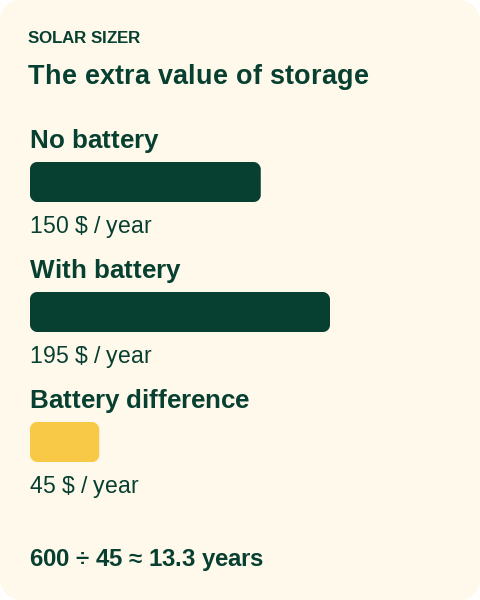
The graphic uses assumed teaching values. Your live results come from your inputs and the published reference data.