What the reviewed law says today
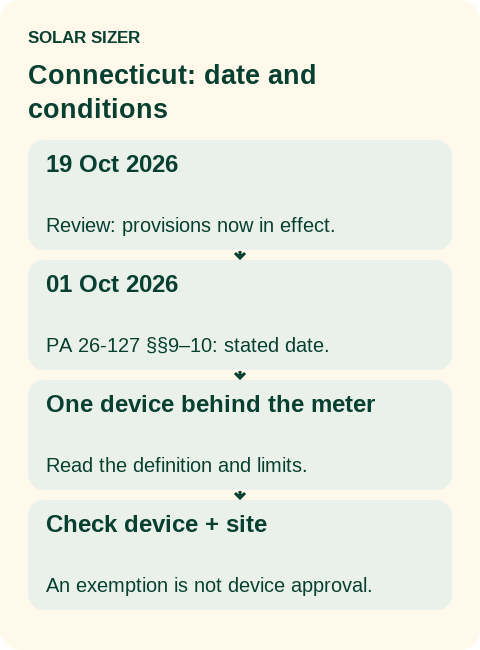
Connecticut Public Act 26-127’s portable-solar provisions in §§9–10 took effect on October 1, 2026. The enacted text and legislative summary were rechecked on October 19, 2026. The Act provides a specific exemption for a qualifying device; it does not exempt every small solar kit from every requirement.
The General Assembly’s energy-law summary identifies the date, and the enacted Act provides the actual definition and conditions. These sources are more useful than a headline saying a bill “passed.” This review covers the Act and legislative summary, rather than every later code amendment or utility implementation notice.
Keep this state-specific route separate from a savings estimate. The US law overview provides other reviewed states, including separate Utah and California records.
A qualifying device has more than a power limit
Section 9 defines a portable solar generation device through several conditions. Among them are:
- It is not permanently affixed to a structure and has a maximum power output of no more than 1,200 W.
- It is designed for a standard 120 V AC outlet behind the customer’s electric meter and is primarily intended to offset the customer’s consumption.
- It meets the State Building Code, the National Electric Code (NFPA-70) and IEEE 1547 requirements.
- It is certified by UL or an equivalent nationally recognized testing laboratory and meets UL 1741 requirements.
- It includes a device or feature that prevents the system from energizing the building’s electrical system during a power outage.
- It includes the Act’s consumer warning about how excess generation may be recorded by the meter.
This is a reading guide to the definition, not a certificate for a product. Obtain the listing and documentation for the exact regional model and complete configuration. The review evidence checklist helps distinguish certification from a reviewer’s performance claim.
One device and a limited interconnection exemption
Section 9(b) exempts a qualifying device from interconnection-agreement requirements imposed by PURA regulations or decisions, provided no more than one such device is used behind the customer’s electric meter. Splitting one intended installation into several smaller kits is not a way to infer extra allowance.
The section expressly retains applicable building, fire safety, fire prevention and local ordinance or regulation provisions. Section 9(c) addresses utility approval, related fees and extra controls or equipment, subject to the stated one-device condition. An exemption from one process does not establish that a particular mounting arrangement meets every retained rule.
Section 10 calls for consideration of safe-installation provisions in future building and fire code amendments. Check current state and local guidance alongside the enacted text when you are ready to install.
The metering warning can change the economics
The device definition requires a warning that generation exceeding the customer’s consumption will be charged as usage unless the customer uses a meter that allows net metering. Do not assume that every existing meter credits exported electricity, or that the bill simply ignores it.
Ask the utility or meter operator how your specific meter records reverse flow and what arrangement applies. Record the answer with your scenario. The distinction between generation, on-site use and exports is explained in the first-month measurement guide.
Solar Sizer assigns exports zero value. It does not model a meter charging exported energy as usage, and it does not calculate Connecticut net-metering credits. Where either matters, its result is an incomplete economic comparison and may overstate the avoided bill. Resolve the metering question before relying on the estimate.
What to gather before buying
- Save the current enacted text and confirm the effective date and later guidance.
- Match the product’s complete documentation to every part of the definition, including outage behavior and the warning.
- Confirm the one-device arrangement, property conditions and retained code requirements.
- Obtain written metering information, then prepare a complete price and household-use estimate.
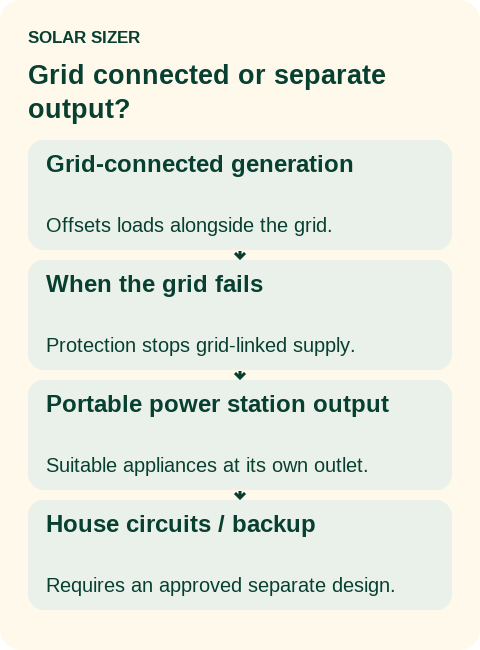
Use the site checklist for the proposed space. A battery does not automatically provide house-circuit backup: the portable-power comparison explains that separate task.
The calculator has no Connecticut-specific weather dataset. Its New York option is south-facing vertical reference weather only, not a Connecticut address or ZIP forecast. You can explore an explicitly labeled reference scenario, but do not treat the city selection as a device or connection approval.
Sources & further reading
- Connecticut General Assembly: enacted PA 26-127, §§9–10 (PDF)
- Connecticut OLR: 2026 Acts Affecting Energy and Utilities, page 8
- UL Solutions: plug-in solar certification framework
- Solar Sizer: data and model boundaries
Worked examples use assumed values and are not product tests. A question or correction? Contact the publisher.
Make it personal
Turn a useful guide into your own comparison.
Put your notes into a comparison with and without storage. Change an assumption and see what it affects.
Compare solar & storageCheck the rules first