Two products can use sunlight for different jobs
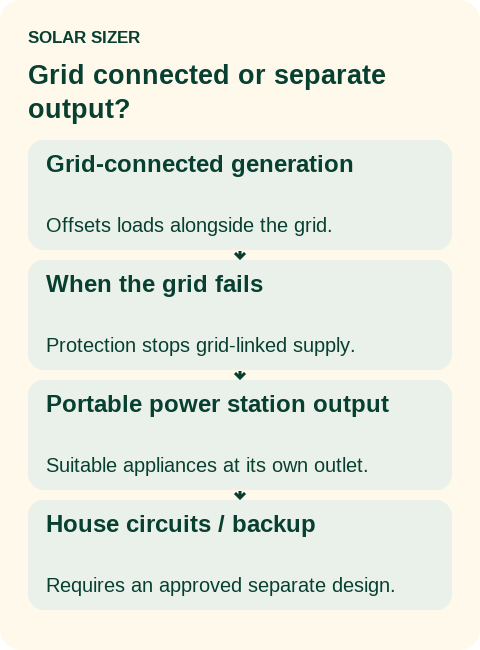
Grid-connected plug-in solar is aimed at offsetting household electricity use alongside the grid. A portable power station stores energy and can supply suitable appliances from its own documented outputs. Neither label alone promises backup for your house circuits.
The word “portable” in a state solar law can describe a grid-connected generation device. It does not automatically mean an isolated battery box used for camping. Likewise, an AC charging inlet on a power station does not establish that it is certified to export electricity into a wall outlet.
Begin by choosing your task: lower daytime grid imports, move solar energy into the evening, or run specific appliances during an outage. The first solar planning guide helps turn that task into a home brief.
Compare the paths that the electricity follows
| Question | Grid-connected plug-in solar | Portable power station |
|---|---|---|
| Normal purpose | Offset on-site use while connected to the grid | Store energy and supply loads at documented outputs |
| During a grid outage | Required grid-linked supply protection stops energizing the building system | A separate output may run suitable appliances if the model supports it |
| Battery present? | Optional; system architecture still matters | Usually a central feature, with model-specific usable energy |
| House circuits | Grid-connected use under the applicable route | Requires a separately approved integration or transfer design |
| Economic comparison | Avoided imports, losses, costs and tariff treatment | Charging source, actual loads, usable energy and purchase goal |
These are functional categories, not a specification for every model. Read the manufacturer’s operating manual and certification for the actual product and mode.
Why a battery does not automatically mean house backup
A grid-connected inverter needs appropriate protection when the external grid is absent. Utah’s reviewed HB 340 text and Connecticut PA 26-127 expressly describe preventing the system from energizing the building’s electrical system during a power outage. That is a distinct requirement from an isolated outlet that may be available on another part of a product.
A manufacturer may document a separate output for designated appliances, an EPS mode or a complete transfer arrangement. Those are different configurations and should not be inferred from battery size. Do not infer grid-export compatibility from matching connectors or an AC outlet.
Use the state-law overview for a grid-connected route and the retrofit guide for the exact equipment architecture. For an outage goal, ask a qualified installer about a documented design suitable for that goal.
Read watts and watt-hours before comparing runtime
W is the output power at a moment; Wh or kWh is stored energy. A 1-kWh label does not mean the device can provide 1 kW continuously under every condition. Continuous power, surge capability, temperature limits, usable capacity and conversion loss all need checking.
For a unit-only illustration, 800 Wh of energy delivered to a constant 100 W load would last 800 ÷ 100 = 8 hours. This is deliberately a simplified assumption, not the runtime of a named product. If 800 Wh is a battery label rather than energy delivered at the output, the calculation leaves out losses and reserves. Appliances also cycle and may have a starting surge.
List the essential appliances and their actual operating needs. Keep power limits separate from energy capacity, and compare the measured output test to the load you intend to use.
Which question Solar Sizer can answer
The tool compares solar without storage to DC-coupled storage under one shared AC output limit. It includes modeled direct use, storage losses and continuous battery overhead. It does not calculate backup runtime, separate AC-battery operation, transfer designs or time-of-use trading.
If your goal matches that scope, use the plug-in solar and battery calculator and inspect additional battery savings against the same solar-only setup. If your goal is a portable output during an outage, collect product-specific output tests and load data instead.
Before purchasing either category, confirm the complete price, required accessories, charging options and regional model. The quote checklist makes that comparison more useful than comparing battery labels alone.
Sources & further reading
- UL Solutions: grid-connected plug-in solar certification framework
- Utah Legislature: HB 340, outage condition in the definition
- Connecticut PA 26-127: §9 device definition
- Verbraucherzentrale: grid-connected Steckersolar versus isolated systems (German)
- Solar Sizer: data and model boundaries
Worked examples use assumed values and are not product tests. A question or correction? Contact the publisher.
Make it personal
Turn a useful guide into your own comparison.
Put your notes into a comparison with and without storage. Change an assumption and see what it affects.
Compare solar & storageCheck the rules first