A best-product claim needs a specific task
The best kit in someone else’s test is not automatically the right kit for your site, tariff or household. Start with the exact regional model, the documented system and the test conditions. This is a checklist for reading third-party reviews. Solar Sizer has not performed hardware tests for it and does not award product rankings.
A review may address certification, measured performance, household economics or purchase experience. Those are useful but different kinds of evidence. A high output figure does not prove a legal connection route, compatibility with an added battery or a worthwhile price.
Give your shortlist a concrete purpose: offset daytime use, add storage to existing panels, or provide a documented separate appliance output. A review for a different purpose can be informative without answering your purchase question.
Check the listing before the performance headline
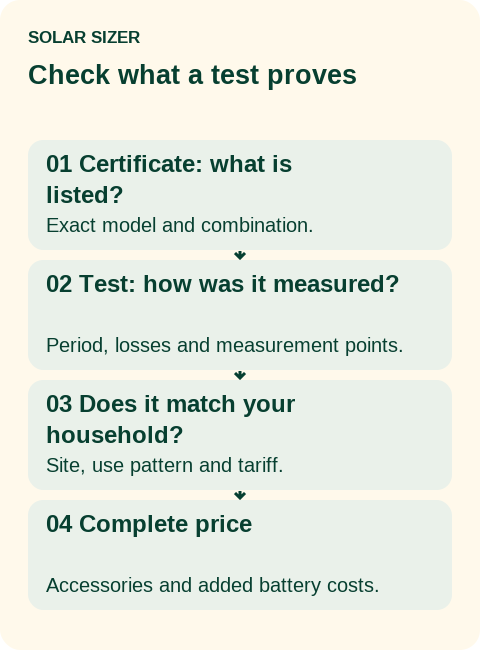
Write down the manufacturer, complete model name, regional version and extra components. Ask for the listing or certification that identifies the system and its intended use. A certificate for one module or battery component need not cover the combination sold in a package.
UL’s plug-in solar framework discusses testing and certification for grid-connected use. Your applicable state text and the actual equipment documents determine the relevant conditions; a foreign model or a matching connector is not sufficient evidence.
The state-law overview helps locate reviewed requirements. If adding storage changes the configuration, the retrofit guide keeps compatibility separate from price.
Look for a test you can interpret
| What the review should identify | Why it matters |
|---|---|
| Place, dates, weather and panel orientation | A bright day does not establish annual output |
| Exact panels, inverter limit and battery size | The measured combination needs to be reproducible |
| Nominal energy and usable output energy | A kWh label is not the same as delivered energy |
| Conversion losses and continuous overhead | These can materially affect a small storage system |
| Measurement points and household load | DC input, stored energy and AC output differ |
| Price date, accessories and export assumptions | A headline price or export credit may not apply to you |
Watch for a theoretical panel maximum presented as a measured household saving. Ask whether the test records real energy over a stated period and distinguishes direct use from exported electricity. If important details are missing, keep them marked as unknown rather than inventing precision.
Compare with your own use and tariff
Two households can consume the same annual kWh while using different amounts of solar directly. Daytime use, available charging surplus, evening demand, shade and tariff structure determine whether the published test is a useful comparison for you.
The battery-value guide separates total solar savings from the battery’s extra value. Use the calculator only when its flat-price, zero-export-value and shared-output DC assumptions fit the question. It is not a ZIP forecast or a hardware test.
For an outage goal, review the portable-power comparison. A reviewer running an appliance from a separate outlet does not prove that the product can safely supply your house circuits.
Build a short evidence-led comparison sheet
For each candidate, record the model, listing, source and review date, setup, measured output boundaries, unresolved questions and final price. Keep certification documents separate from a sponsored review or an affiliate offer. A commercial relationship is relevant context, not by itself proof that a result is either good or bad.
The complete quote checklist includes mounting, controls, cables, shipping, taxes and fitting. Check warranty provider, current regional stock and returns at the seller. Compare systems only after documenting important differences.
Resolve the item that could change the decision before buying. A shortlist with visible evidence and gaps is more useful than a ranking that hides its assumptions.
Sources & further reading
- UL Solutions: plug-in solar testing and certification framework
- US Department of Energy: household suitability and purchase decisions
- Connecticut PA 26-127: device requirements as a state-specific example
- Solar Sizer: data and model boundaries
Worked examples use assumed values and are not product tests. A question or correction? Contact the publisher.
Make it personal
Turn a useful guide into your own comparison.
Put your notes into a comparison with and without storage. Change an assumption and see what it affects.
Compare solar & storageCheck the rules first