Signing is confirmed in the official record
New Jersey’s Garden State Balcony Solar Act was signed on September 1, 2026. The Governor’s announcement names S2368/A4836, and the Legislature’s history records approval as P.L.2026, c.82. This article reviewed those records and the latest accessible third reprint on September 30, 2026. The final chapter-law copy was not located in the official public directory during this review.
The useful next question is whether your actual device and proposed arrangement qualify. The announcement describes exemptions for qualifying devices up to 1,200 W, rather than approval for any imported kit with an adjustable limit. Use the reviewed third reprint with the bill record when checking scope and dates.
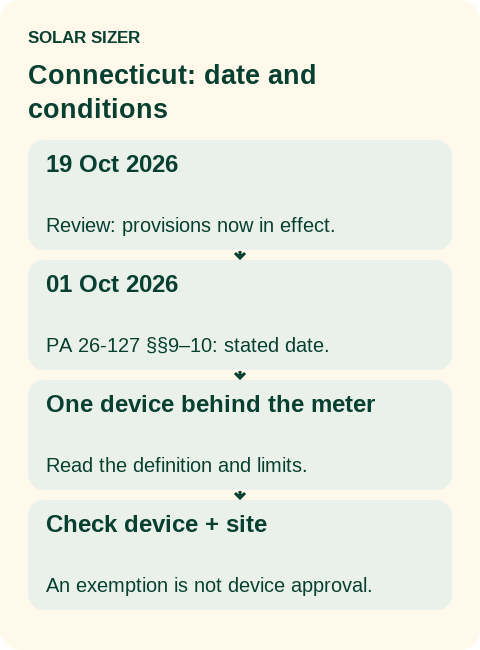
For context, the state-law overview separates this record from the California bill stage and Connecticut’s October 1 provisions. Rules from one state are not a substitute for another state’s text.
Effective date: the reviewed text says six months
Section 5 of the third reprint says the Act takes effect six months after enactment, with anticipatory action permitted for the Board. Applied to the confirmed September 1 signing date, that would point to March 1, 2027 if the provision is unchanged in the final approved text. This is a reading of the accessible version, not an independently verified final chapter-law effective date.
At the September 30 review date, do not treat the signing announcement as proof that every exemption is already in force. Ask for the approved text and any current Board guidance before relying on a connection exemption.
Read the qualifying device before the exemptions
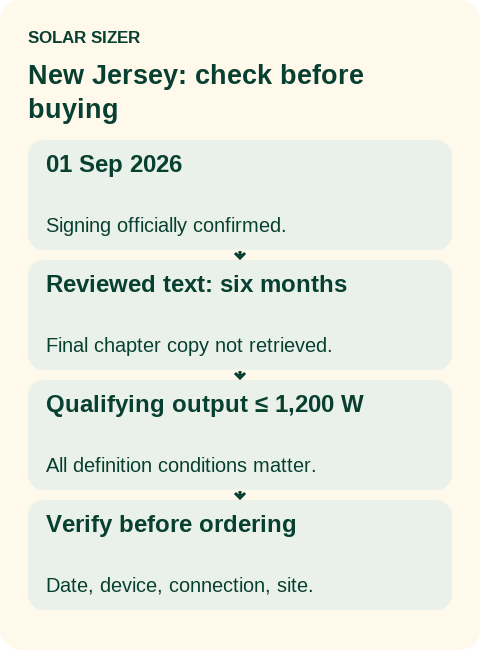
The reviewed third reprint defines a moveable photovoltaic device and associated equipment with no more than 1,200 W output, designed for a standard 120 V AC outlet on the customer’s side of the meter to primarily offset consumption. It requires listing or certification under UL 3700, a comparable standard or a combination addressing plug-in photovoltaic safety and grid-parallel use by a nationally recognized testing laboratory. Its outage feature prevents export to the electrical distribution system during a power outage.
Section 2(f) applies a combined maximum of 1,200 W at one service address or dwelling unit, unless an interconnection agreement is obtained for greater output. Section 2(e) retains applicable installation provisions and describes a narrower exception for output to the receptacle of 400 W or less. These are distinct conditions; neither battery kWh nor panel Wp is a substitute for AC output.
Ask the seller for exact model names, the regional version, the evaluated equipment combination and certification documents. A certificate for a panel or battery component does not necessarily list the assembled system for its intended grid-connected use.
The guide to comparing solar reviews helps you ask what a test proves. It cannot substitute for the actual listing. If a storage add-on changes the combination, use the battery compatibility checklist before assuming the original evidence still applies.
What the exemptions do—and the questions they leave
The Governor’s announcement says the law exempts qualifying devices from specified utility interconnection and metering requirements, including certain fees, approvals and equipment mandates. It also describes restrictions on broad prohibitions by landlords, associations and similar entities, and on municipalities prohibiting the devices or requiring permits for their use.
Read those descriptions alongside the reviewed text. Its tenant provision includes written notice and device/location documentation at least 14 days before placement or use, plus reasonable size and placement restrictions. The municipality provision does not exempt building modification or electrical work from applicable code and permit or inspection requirements. Check whether these provisions are unchanged in the approved chapter law. A property protection is not proof that every railing, cable route or equipment combination is appropriate. Keep the original text and the exact product documentation together when resolving a disagreement.
This source review does not claim that every implementing notice, current utility practice or property dispute has been audited. Ask the relevant utility or qualified local adviser about a specific question and record which provision their answer addresses.
Outage power is a different purchase goal
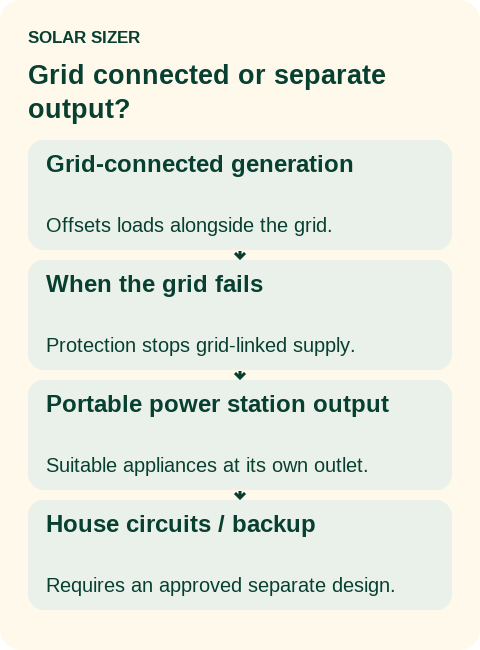
A grid-connected device normally offsets electricity consumption while the grid is present. Anti-islanding or outage-protection requirements do not create a promise to keep house circuits running when the grid fails. A storage product may have a separate appliance outlet, but that feature must be documented for the exact product.
The plug-in solar versus portable power station guide compares the two functions without treating a battery label as a backup design. If your priority is outage operation, establish the load, output and approved transfer arrangement before evaluating bill savings.
Build a site-specific checklist and cost comparison
- Confirm the current text, effective provisions and later guidance.
- Match output, connection, complete-system certification and outage behavior to the definition.
- Clarify mounting and any property-specific questions with the actual location and dimensions.
- Verify how your meter and tariff treat imports and exports; do not assume export credit.
- Collect full solar-only and battery-added prices for the documented combination.
The site checklist and complete quote comparison keep these facts visible. An unknown installation or accessory cost should remain unknown until clarified.
Solar Sizer has no New Jersey-specific dataset. Its New York reference is limited to south-facing vertical panels; it is not a New Jersey ZIP estimate. The model uses a flat electricity price, zero export value and DC storage under a shared AC output limit. A tariff or product outside those assumptions needs a different calculation.
Sources & further reading
- New Jersey Legislature: S2368 third reprint, June 28, 2026 (PDF; final chapter copy not retrieved)
- New Jersey Legislature: S2368 record and history
- New Jersey Governor: September 1, 2026 signing announcement
- UL Solutions: grid-connected plug-in solar testing framework
- Solar Sizer: data and model boundaries
Worked examples use assumed values and are not product tests. A question or correction? Contact the publisher.
Make it personal
Turn a useful guide into your own comparison.
Put your notes into a comparison with and without storage. Change an assumption and see what it affects.
Compare solar & storageCheck the rules first